Every sports fan has lived the same nightmare. The final is minutes away, the live scores page freezes, and the feed that should show the latest result just says "loading". Behind that spinner is usually a small team of engineers who realized too late that nobody was watching the right metric. If you work on a sports data service, a ticketing system or a race timing platform, the skill that prevents that moment is monitoring, and one of the most recognized ways to prove it is the Prometheus Certified Associate. This article looks at the Prometheus Certified Associate (PCA) practice tests from Be Ready Education, what they contain, and who will get value from them.

Be Ready Education page for the Prometheus Certified Associate practice tests, showing 5 timed tests, 300 questions, 90 minutes per test and a 75% pass mark
Why match-day traffic makes monitoring a real skill
Sports platforms have a traffic shape that most business software never sees. Load is quiet for days, then a kickoff, a photo finish or a record-breaking sprint sends thousands of people to the same page in the same minute. In that window, an engineer needs answers fast. How many requests per second are we serving? What share of them fail? Is the delay in our own code or in the data provider we scrape every few seconds?
Prometheus is built for exactly these questions. It collects numeric measurements over time, lets you query them with its own language called PromQL, and fires alerts when something drifts. The Be Ready Education page describes the exam as covering "Prometheus monitoring, PromQL queries and alerting", and the same page lists the people it suits as site reliability engineers, DevOps engineers and platform engineers.
That list is worth taking seriously. If you are a developer who only touches dashboards once a quarter, this certification is probably more than you need. If your phone rings when the live feed stalls, it is aimed squarely at you.
What the practice tests actually contain
According to the course page, which was last updated on 1 November 2026, the package is straightforward:
- 5 full-length timed tests
- 60 questions in each test, 300 questions in total
- 90 minutes per test, which works out to about 90 seconds per question
- a 75% pass mark on the practice tests
- a written explanation for the correct answer and for every incorrect option
The page says the questions are "original questions written around the topics and style of the Prometheus PCA exam". The site also states that Be Ready Education is an independent publisher not affiliated with the certification provider. That matters if you have been tempted by shortcut sites. Original questions mean you practice the skill instead of memorizing someone else's answers, and the explanations are where the learning happens.
The wider catalogue is not tiny either. The exams index on bereadyeducation.com lists 36 practice-test courses, and the page says each has five full-length timed tests with every answer option explained. The PCA course sits in that same format, so if you later move to another cloud native certification, the routine will feel familiar. The PCA page itself points to OpenTelemetry OTCA as the next certification in the path.
The topics that trip people up
The course page does not publish domain weightings, so I will not invent any. What it does show is a comparison section covering four pairs of ideas that regularly cause confusion:
1. Counter versus gauge. A counter only goes up, like total goals recorded in a season, while a gauge can move both ways, like the number of users on a live page right now. Pick the wrong one and your graph lies.
2. rate() versus irate(). Both turn a counter into a per-second speed, but one smooths over a window and the other reacts to the last two samples. During a traffic spike the difference changes what your alert sees.
3. Histogram versus summary. Both describe response times, but they aggregate differently across servers. This is a classic question because the correct answer depends on your setup.
4. Scraping versus Pushgateway. Prometheus normally pulls metrics from services. Short-lived jobs, such as a script that processes final standings overnight, may need a different path.
The page also includes one sample question about a gauge, with the answer shown as D. It is a small taste, but enough to judge whether the writing style and the level of detail suit you before you open the course.
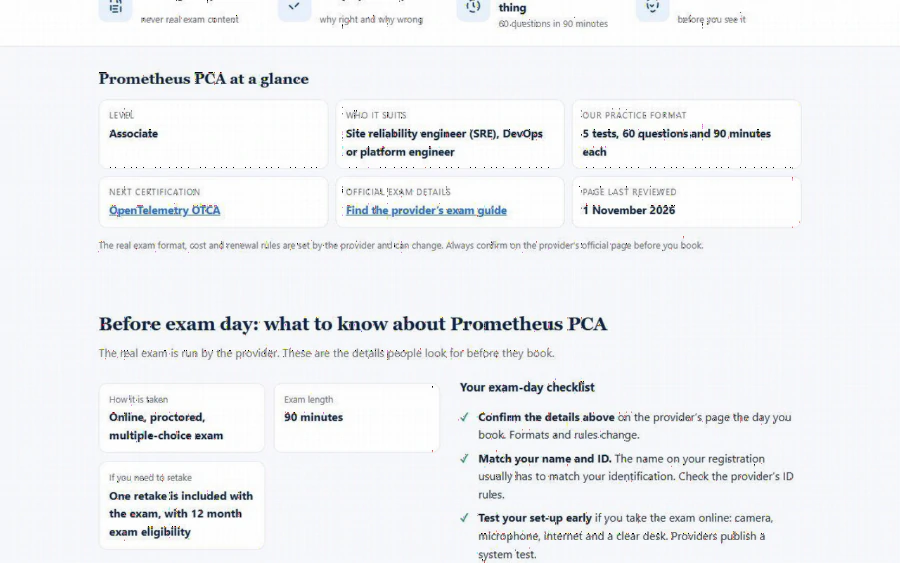
Be Ready Education Prometheus PCA page section showing the exam at a glance, who it suits and exam-day details such as the 90 minute proctored online format
How to use the five tests like a training week
Athletes do not improve by watching the match, they improve by drilling under conditions that resemble it. The page suggests the same idea. Its stated method is to open the course, take Test 1 under exam conditions, review every explanation, and repeat until you reach 85% on two tests in a row. The 85% target is higher than the 75% pass mark on purpose, because it leaves room for a bad day.
Here is a plan that fits a working engineer:
- Week one, baseline. Take Test 1 with the timer running and no notes. Your score matters less than the list of topics you missed.
- Week one, review. Read the explanations for every question, including the ones you got right. The wrong-option explanations are the most useful part, since they show how the exam writers build plausible distractors.
- Week two, target the weak spots. Go back to the counter, rate and histogram material in your own Prometheus instance. Run the queries, break them on purpose, and see what the graph does.
- Week two, repeat. Take Tests 2 to 5 spaced across several days. Stop only when two in a row clear 85%.
The site also offers free tools alongside the course: an exam timer, a pass score calculator, a practice score tracker, and a study plan in 2-week and 4-week versions. If you only have evenings, the 4-week version is the realistic one.
Strengths and limits, stated plainly
What it does well. The format is predictable and the explanations are thorough. Each test runs 90 minutes, the same length the page gives for the official exam, so the pacing practice is useful. The money-back guarantee of 30 days and the lifetime access are both stated on the page, with refund and access terms set by Udemy, where the course is sold.
What it does not do. It will not teach you Prometheus from zero. If you have never written a query, start with the official documentation and a local install, then use the tests to find gaps. The questions are original, which is good ethically, but it also means no set of practice questions can promise the same wording on exam day. No practice product can guarantee an outcome, so treat the scores as a signal rather than a verdict.
Price. The course page does not state a price. It says the current price and any offers appear on Udemy when you open the course, so check there rather than relying on a number in an article.
Who should and should not use it
Use it if you run or support production services, you already have some hands-on time with Prometheus, and you want a structured way to find what you do not know before booking the exam. It suits site reliability engineers, DevOps and platform engineers most directly.
Skip it, or at least delay it, if you have not touched metrics and alerting yet. Build a small exporter, scrape it, write five queries, and set one alert first. After that the practice tests will measure something real.
On exam details, the course page says the official exam is online, proctored and multiple-choice, runs 90 minutes, and includes one retake with 12 months of eligibility. It also reminds you to confirm everything on the provider's own page, because rules change. That is sensible advice, and worth following the day you book.
Where to start
Open the course page, read the sample question, and decide honestly whether the style suits you. If it does, run Test 1 this week with the timer on, and write down which of the four confusing pairs above cost you points. You can also browse the other certification courses in the catalogue if monitoring is only one step in a longer cloud native plan.
The next time the live feed freezes on a big match day, the engineer who has already practiced reading metrics under a clock will be the one who finds the cause in minutes rather than hours.