Ask any coach what separates a good season from a great one and you will hear the same answer: it is rarely talent alone. It is how the athlete trains between matches. A runner who logs miles without ever reviewing split times plateaus. A footballer who only practices the drills they already enjoy never fixes the weak foot. Exam preparation works the same way, and nowhere is that clearer than with cloud certifications such as SAP Certified Associate, SAP Business Technology Platform.
Practice questions are the training ground. But many candidates use them badly, and the result is a lot of hours with little improvement. Here are the mistakes that show up most often, and what to do instead.

A candidate in a business suit with a certificate graphic and a cloud platform diagram behind her, the cover image of the SAP BTP Associate practice course
Mistake 1: Chasing the score instead of the reason
The most common habit is treating a practice test like a scoreboard. You finish, you see 68 percent, you feel either relieved or discouraged, and you move on to the next test. That is like checking the final result of a match and never watching the replay.
A score only tells you where you stand. The explanation behind each answer tells you why. When you get a question right, ask whether you knew it or guessed it. When you get one wrong, write down the single idea you were missing, for example the difference between a subaccount and a directory, or when a managed service fits better than a custom build. Ten written lines after each test are worth more than another full test taken straight away.
Mistake 2: Memorizing answers instead of learning patterns
If you sit the same questions repeatedly, your score climbs, but your understanding does not. You start recognizing the wording rather than the concept. The moment the exam phrases a scenario differently, the advantage disappears.
A better approach is to treat every question as a small case study. Cover the options and try to predict the answer first. Then read all four options, not only the correct one. Understanding why three options are wrong is how you learn the boundaries between services, which is exactly what scenario questions test. Good practice material explains every option for this reason.
Mistake 3: Skipping the timer
Many people practice casually, pausing to look things up, checking a second tab, answering over two evenings. It feels productive and it is comfortable. It is also nothing like exam day.
Pace is a skill. Under time pressure you will meet questions you cannot answer cleanly, and you need a routine for them: pick the best option, flag it, move on. The Be Ready Education course on Udemy is built around five timed tests with 30 questions each, which gives you 150 questions in total and several chances to rehearse that routine. Take at least your last two tests with a strict timer, no notes and no pauses.
Mistake 4: Ignoring your weak topics because they feel slow
Every candidate has a topic they quietly avoid. For SAP BTP it is often the areas that sit between development and administration: security concepts, connectivity, or how services are provisioned and consumed across environments. Practice tests keep returning to these topics because real projects do.
Sort your missed questions by topic after every test. If one theme shows up three times, stop taking new tests and go back to the official learning material for that theme. Then return to practice. This loop of test, diagnose, study and retest is the whole method. Athletes call it targeted training, and it is much more efficient than repeating a general routine.
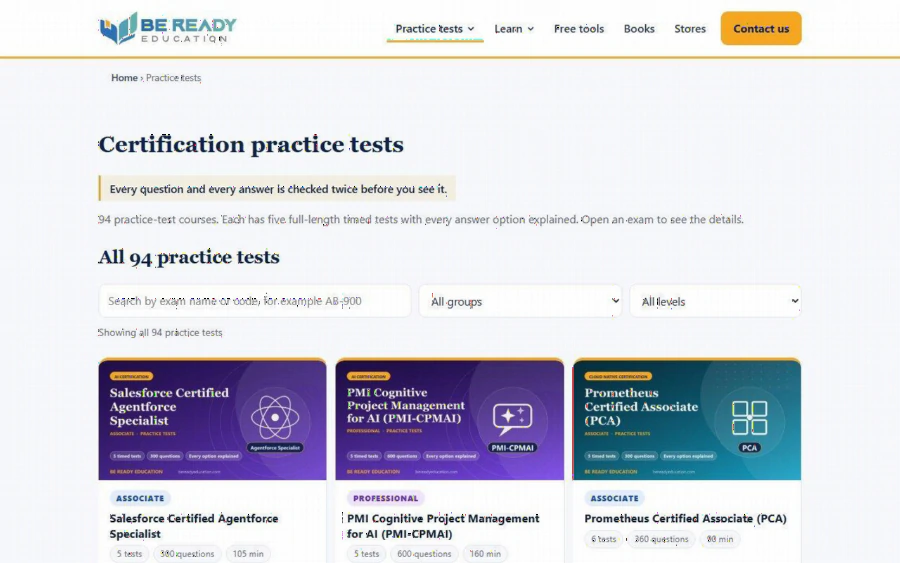
The Be Ready Education certification practice tests page showing a catalogue of practice courses with test counts, question counts and durations
Mistake 5: Rushing the question stem
Under pressure, people read the first sentence and jump to the options. Cloud platform questions are often built so the deciding detail sits in the last line: a constraint about cost, security, an existing system landscape, or a requirement to avoid custom code. Miss it and a plausible option looks correct.
Train yourself to underline the requirement before you look at the answers. Ask what the question is really optimizing for. Then eliminate options that break that requirement, even if they are technically valid in other situations. Most wrong answers on associate-level exams are not absurd. They are right answers to a different question.
Mistake 6: Treating practice tests as a substitute for the real material
Practice questions sharpen what you already know and expose what you do not. They do not replace hands-on time with the platform or the provider's own learning content. If you can, open a trial account and click through the services you keep missing. A few hours of real use will make abstract questions concrete.
It is also worth being honest about what practice tests cannot do. The Be Ready Education questions are original practice material, written independently and not affiliated with SAP. They do not contain real exam content, and no course can promise a result. SAP sets the real exam format, number of questions, passing score and retake rules, and these can change, so check SAP's official certification page for the exact exam you plan to book before you sit it.
A simple weekly plan that avoids all six mistakes
Here is a rhythm that works for people balancing study with a job or classes:
1. Take one timed test and record the score, but do not react to it.
2. Spend the next day on review only. Read every explanation, including for questions you got right.
3. Write down your top three weak topics and study them from the official material.
4. Do a short untimed set on those topics.
5. Repeat with the next test, and keep the final one as a full dress rehearsal.
Over a few weeks you will see the real change: not only a higher score, but fewer guesses, faster decisions and a clearer picture of how the platform fits together.
Where to practice
If you want a structured set of questions to apply this method, the SAP BTP Associate practice tests from Be Ready Education give you five full tests of 30 questions each, with a written explanation for every answer option. You can also browse the wider range of certification practice tests to see how the courses are organized.
Whatever material you choose, remember the coach's rule. The score is the result, but the review is the training. Candidates who learn from each mistake, rather than just count them, are the ones who walk into the exam calm, paced and ready.